RV insurance in Texas: why it matters more than you might think
Whether you spend every weekend hitching up your fifth wheel at Garner State Park or you have traded a fixed address for the open road full-time, RV insurance in Texas can protect you from a genuinely painful financial situation. Texas roads, Texas weather, and Texas liability law all create risks that a standard auto policy was not built to handle. Knowing what coverage you need, and what you might be missing, is the first step toward hitting the road with real confidence.
What RV insurance actually covers
A purpose-built RV policy is different from the liability endorsement your auto insurer may have added to your tow vehicle. A standalone RV policy typically bundles several types of protection into one package.
- Liability coverage pays for bodily injury or property damage you cause to others in an accident. Texas requires all vehicles operated on public roads to carry at least $30,000 per person / $60,000 per accident in bodily injury and $25,000 in property damage , but those minimums go fast when a motorhome is involved.
- Collision coverage pays to repair or replace your RV after a collision, regardless of fault.
- Comprehensive coverage covers non-collision losses: hail, fire, theft, falling objects, and flooding. Given North Texas hailstorms and Gulf Coast hurricanes, this coverage earns its premium.
- Uninsured/underinsured motorist (UM/UIM) : Texas law requires insurers to offer this, and you must reject it in writing to remove it. Do not.
- Personal effects / contents coverage protects clothing, electronics, camping gear, and other belongings stored inside your RV. Your homeowners or renters policy probably does not follow you down the highway.
- Emergency expense coverage pays for lodging and transportation if your RV is disabled far from home.
- Roadside assistance : towing an RV is not cheap. A Class A motorhome can cost $500 or more per tow without coverage.
Full-timers vs. weekend travelers: the coverage gap that surprises people
This is the distinction most people do not think about until something goes wrong. If you live in your RV full-time, meaning it is your primary residence, a standard RV policy may leave you underinsured. Full-timer coverage is a special endorsement that treats your rig more like a home than a vehicle.
Why full-timer coverage is different
A full-timer policy adds personal liability protection similar to what a homeowners policy provides. If a visitor trips and falls inside your RV while it is parked at an RV park in Fredericksburg, standard auto liability does not cover that. Full-timer liability does. It also typically includes higher limits for personal belongings, because when the RV is your home, everything you own is in it.
Some carriers define "full-timer" as living in your RV more than 150 days per year. Others set the threshold at six months. Be honest with your agent about how you use the rig. Misrepresenting use is the kind of detail that can give an insurer grounds to deny a claim.
What weekend travelers need instead
If you pull out the camper a few times each summer and store it at home the rest of the year, your coverage needs look different. You still need liability, collision, and comprehensive, but you may qualify for vacation liability coverage that activates only when the RV is parked and in use as a temporary residence. Storage-only policies, which suspend liability coverage when the unit is not in use, can also reduce premiums significantly during off-season months.
Texas-specific risks every RV owner should factor in
Texas is not a small or gentle state. Its geography alone creates insurance considerations that RV owners in other parts of the country may not face.
Hail and windstorm
The Dallas-Fort Worth Metroplex sits squarely in Tornado Alley, and hail events here can be severe. A single hailstorm can produce damage in the $10,000 to $30,000 range on a larger motorhome, particularly on fiberglass roofs and slide-out components. Comprehensive coverage handles this, but pay attention to whether your policy values the RV at actual cash value (ACV) or agreed value / replacement cost . ACV subtracts depreciation; agreed value pays what you and the insurer agreed the unit is worth at policy inception. On a five-year-old Class A, that difference can be tens of thousands of dollars.
Flooding
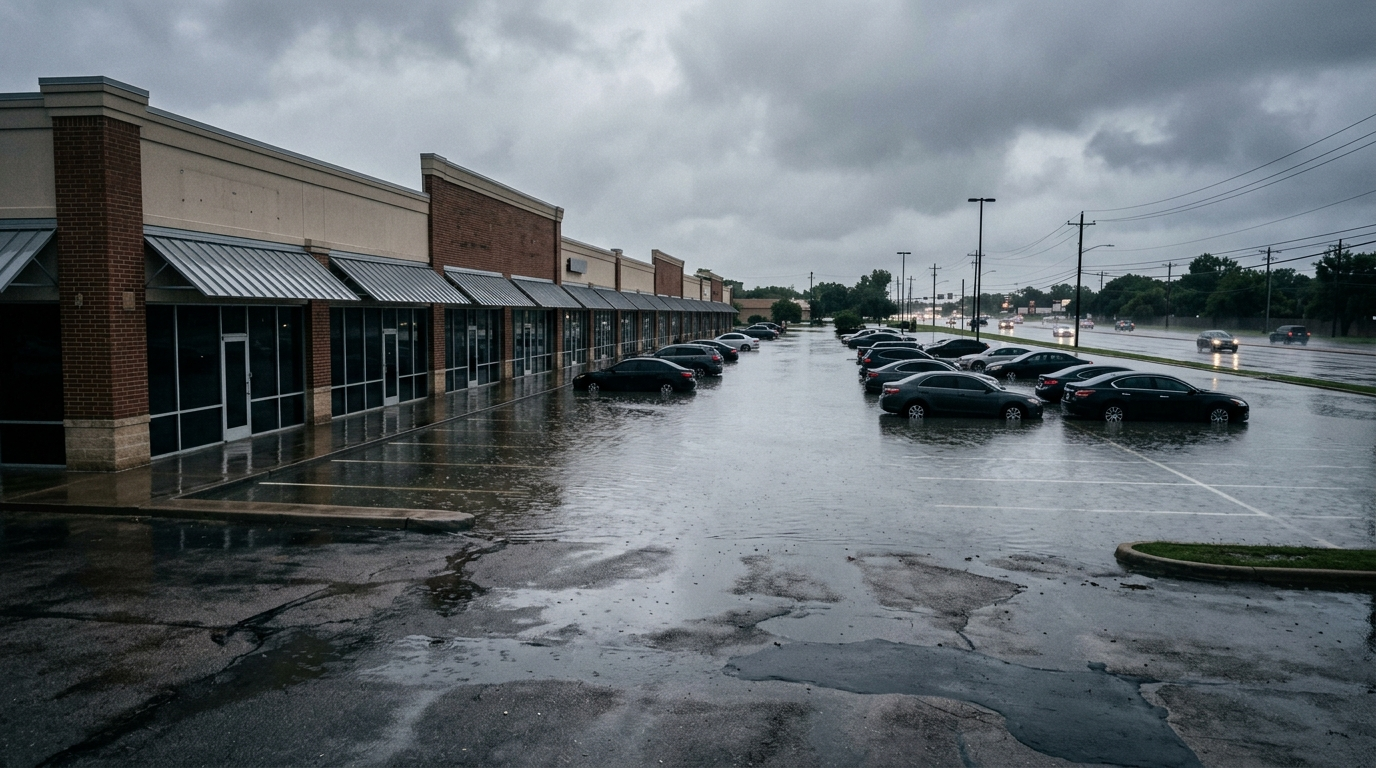
Flash flooding is a recurring problem across Texas, from the Hill Country's "Flash Flood Alley" to low-water crossings throughout the DFW area. Comprehensive coverage on an RV policy does cover flood damage to the vehicle itself. If you park your RV on property and want to protect that property separately, you would need a different type of flood policy entirely. Our post on personal flood insurance in Texas covers the basics.
Extreme heat
Texas summers push cooling systems, seals, and roof membranes hard. Mechanical breakdown is generally excluded from RV insurance and falls under extended warranty territory. Heat-related damage that results in a covered peril, such as a roof seal failure that leads to water intrusion and mold, can sometimes be covered depending on how the claim is documented. Know what your policy says before summer arrives.
Wildlife collisions
White-tailed deer are common throughout Texas, and hitting one in a large motorhome can cause serious damage. Comprehensive coverage, not collision, covers animal strikes. It is a common mix-up that costs people their deductible or, worse, causes them to file the wrong type of claim.
How much does RV insurance cost in Texas?
Premiums vary widely based on the class of RV, how you use it, your driving record, and how much coverage you carry. The figures below are rough benchmarks to give you a starting point.
- Class A motorhomes (large diesel pushers) : typically $1,500 to $3,500+ per year for a full-coverage policy with decent liability limits.
- Class B (camper vans) and Class C motorhomes : often $800 to $1,800 per year , depending on value and use.
- Travel trailers and fifth wheels (towable) : generally the most affordable, ranging from $200 to $750 per year for comprehensive coverage, since they have no engine and carry lower liability exposure while moving.
- Full-timer endorsement : adds roughly $200 to $500 per year depending on the carrier and coverage level.
Factors that can reduce your premium include completing an RV safety course (some carriers offer a discount for this), storing the unit in a covered facility off-season, maintaining a clean driving record, and bundling your RV policy with auto or homeowners coverage through the same carrier. An independent agent can shop multiple carriers at once to find which combination of discounts applies to your specific situation.
Common mistakes RV owners make with their insurance
After writing RV policies across the DFW area and beyond, a few patterns show up repeatedly when people come to us after a claim goes sideways.
- Relying on the auto policy alone : a personal auto policy covers liability while towing in most cases, but it rarely covers the trailer itself and provides no protection for contents or campsite liability.
- Underinsuring the personal contents : people are surprised to add up what they have inside, including laptops, cameras, bikes, generators, kitchen equipment, and hunting gear. It adds up to $5,000 to $20,000 fast. Default contents limits are often too low.
- Not updating coverage after upgrades : solar panels, custom slide-outs, upgraded appliances, and satellite systems add real value. If your policy was written before those additions, you may be insuring a lesser version of your rig.
- Letting coverage lapse during storage : dropping all coverage to save money during storage leaves your unit exposed to theft, hail, and fire at the exact time it is sitting still and vulnerable.
- Skipping a liability limits review : a Class A motorhome is a large vehicle capable of causing serious damage. Carrying only the Texas state minimums is a significant financial risk. Umbrella coverage can provide an additional layer of protection on top of your RV policy. See our page on personal umbrella insurance for how that works.
What to look for when comparing RV insurance carriers
Not all carriers write RV policies the same way. When comparing options, pay attention to these specific policy features rather than just the premium.
- Agreed value vs. actual cash value : as noted above, this is one of the most significant differences in how a total-loss claim pays out.
- Full-timer status and how it is defined : thresholds and coverage terms differ by carrier.
- Attached accessories coverage : awnings, satellite dishes, and slide-outs are often listed separately and may have sublimits.
- Vacation liability : covers you when the RV is used as a temporary residence at a campsite.
- Emergency expense allowance : look for at least $1,500 to $3,000 in lodging and travel reimbursement if the RV is disabled.
- Mexico coverage : if you drive into Mexico, most standard U.S. RV policies stop at the border. Some carriers offer extensions; others require a separate Mexican auto policy.
Get the right RV coverage through Princeton Insurance
Princeton Insurance is an independent agency serving the DFW Metroplex and surrounding communities. As an independent agency, we are not tied to any single carrier. We shop your RV policy across multiple insurance companies to find the combination of price and coverage that fits how you actually use your rig, whether that is a weekend camper parked at Lake Texoma a few times a year or a full-time setup rolling through all corners of Texas.
Visit our RV insurance page for an overview of what we offer, or reach out directly to talk through your situation. You can contact us online at our contact page or call us at (469) 916-9595 . A few minutes with a real agent can make a meaningful difference in how your policy performs when you need it most.
Get A Quote
At Princeton Insurance, securing your future is easy. Ready to protect what matters? Contact us for a quick quote and personalized insurance options!
Kelly
Speak to Kelly 24/7
Microphone ready
Start your custom insurance quote
Instant answers to your insurance questions
Schedule appointments or follow-ups
Personal Insurance
From auto and homeowners to renters and umbrella policies, we help protect your family and property. Let’s find coverage that fits your life.
Commercial Insurance
We customize policies for your industry's risks, like general liability and workers' comp, ensuring you can run your business worry-free.
Contact Princeton Insurance
Recent Posts